Hey @alexmurray - thanks for the feedback - this is very helpful.
I think this could be an upstream issue in syft/grype. I filed it here: https://github.com/anchore/grype/issues/3122
Background
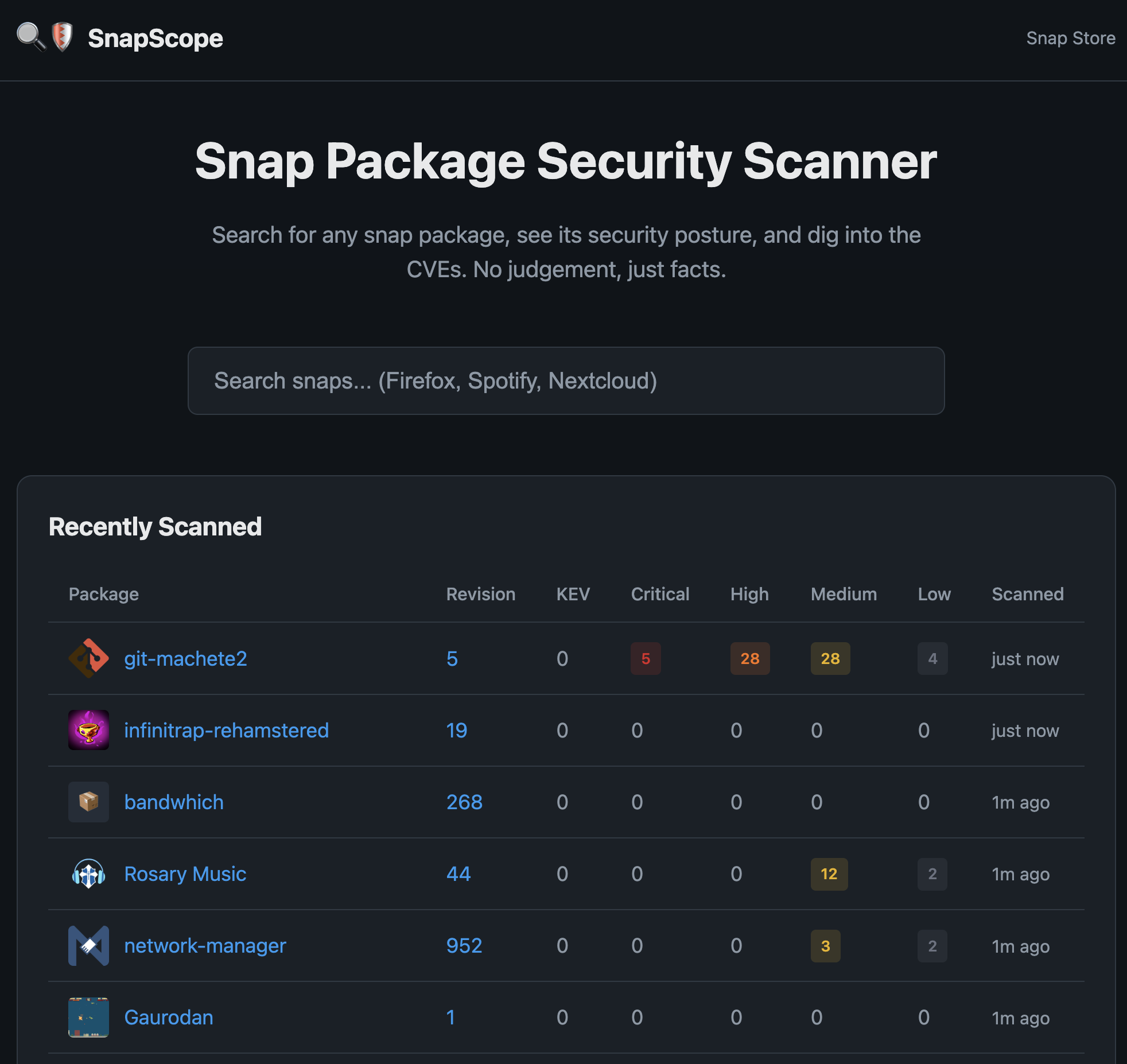
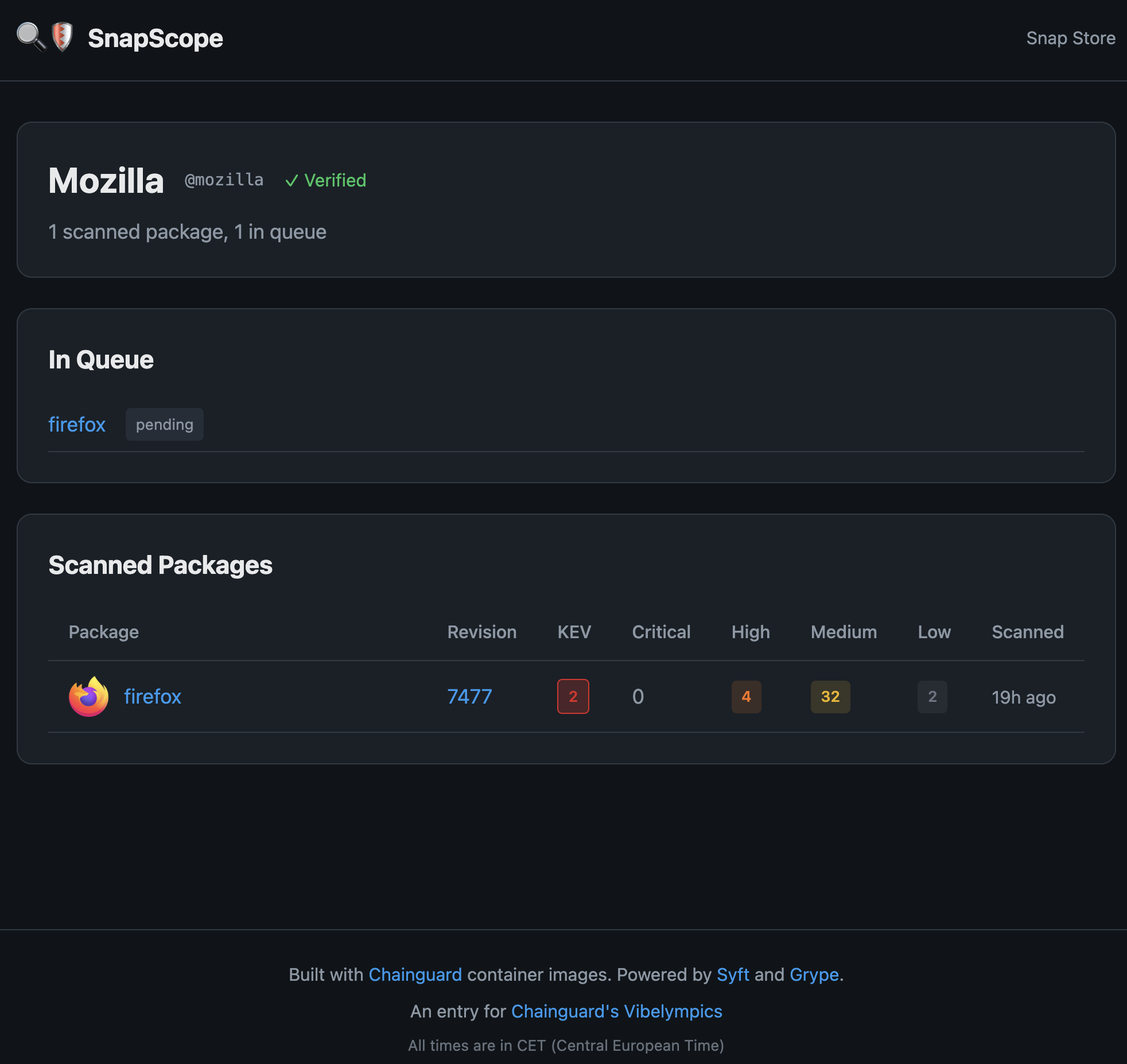
Everything shown is based on data from Syft and Grype.
Grype pulls from distro and other feeds via vunnel, into grype-db.
Syft generates the SBOM, and Snapscope stores that. Grype reads the SBOM and compares it with the vulnerability database, which is updated frequently. Grype also has Syft built in as a library, so while Snapscope uses Syft to build the SBOM, Grype can internally do that, without calling Syft first.
Note that support for introspecting snaps was landed relatively recently (a short while before I left Anchore in September), and there are still missing features, such as scanning specific revisions and specifying different architectures.
Emacs
Let’s look at your specific example, let’s manually run grype against the emacs snap. Note that I’m specifying --distro because otherwise it doesn’t detect the “OS” (base snap) the snap was built on top of (core22,core24 etc). Snapscope does this too.
$ grype snap:emacs --distro ubuntu:24.04
 ✔ Downloaded snap emacs@stable (amd64)
 ✔ Indexed file system 4gE2S31SnK2LeqsZF8XTPuHOlqlzbqsW_3516.snap
 ✔ Cataloged contents 4dfa0a42afe4b18ebe2dc78129c8555e7c7d8d1f5da49883da842b058f51e666
   ├── ✔ Packages                        [355 packages]
   ├── ✔ File metadata                   [5 locations]
   ├── ✔ File digests                    [5 files]
   └── ✔ Executables                     [1,386 executables]
 ✔ Scanned for vulnerabilities     [11 vulnerability matches]
   ├── by severity: 0 critical, 0 high, 5 medium, 6 low, 0 negligible
NAME         INSTALLED                 TYPE  VULNERABILITY   SEVERITY  EPSS           RISK
emacs        30.2                      deb   CVE-2024-39331  Medium    0.4% (62nd)    0.2
binutils     2.42-4ubuntu2.8           deb   CVE-2025-1180   Medium    0.3% (50th)    0.1
emacs        30.2                      deb   CVE-2025-1244   Medium    0.2% (43rd)    0.1
binutils     2.42-4ubuntu2.8           deb   CVE-2017-13716  Low       0.2% (46th)    < 0.1
libgcrypt20  1.10.3-2build1            deb   CVE-2024-2236   Low       0.2% (44th)    < 0.1
emacs        30.2                      deb   CVE-2024-53920  Medium    0.1% (31st)    < 0.1
binutils     2.42-4ubuntu2.8           deb   CVE-2025-1150   Low       0.2% (40th)    < 0.1
binutils     2.42-4ubuntu2.8           deb   CVE-2025-1152   Low       0.2% (40th)    < 0.1
binutils     2.42-4ubuntu2.8           deb   CVE-2025-1151   Low       0.2% (38th)    < 0.1
emacs        30.2                      deb   CVE-2024-30202  Medium    < 0.1% (15th)  < 0.1
libxml2      2.9.14+dfsg-1.3ubuntu3.6  deb   CVE-2025-8732   Low       < 0.1% (0th)   < 0.1
So that’s where the data comes from. Grype also has an ‘explain’ feature, which tells you why a vuln shows up.
$ grype snap:emacs --distro ubuntu:24.04 --output json | grype explain --id CVE-2024-39331
[0000]  WARN grype explain is a prototype feature and is subject to change
 ✔ Downloaded snap                                                                                                                                                      emacs@stable (amd64)
 ✔ Indexed file system                                                                                                                            4gE2S31SnK2LeqsZF8XTPuHOlqlzbqsW_3516.snap
 ✔ Cataloged contents                                                                                                       4dfa0a42afe4b18ebe2dc78129c8555e7c7d8d1f5da49883da842b058f51e666
   ├── ✔ Packages                        [355 packages]
   ├── ✔ Executables                     [1,386 executables]
   ├── ✔ File metadata                   [5 locations]
   └── ✔ File digests                    [5 files]
 ✔ Scanned for vulnerabilities     [11 vulnerability matches]
   ├── by severity: 0 critical, 0 high, 5 medium, 6 low, 0 negligible
CVE-2024-39331 from nvd:cpe (Critical)
In Emacs before 29.4, org-link-expand-abbrev in lisp/ol.el expands a %(...) link abbrev even when it specifies an unsafe function, such as shell-command-to-string. This affects Org Mode before 9.7.5.
Related vulnerabilities:
    - ubuntu:distro:ubuntu:24.04 CVE-2024-39331 (Medium)
Matched packages:
    - Package: emacs, version: 30.2
      PURL: pkg:generic/snap/emacs@30.2?base=core24&type=app
      Match explanation(s):
          - ubuntu:distro:ubuntu:24.04:CVE-2024-39331 Direct match (package name, version, and ecosystem) against emacs (version 30.2).
      Locations:
          - /meta/snap.yaml
URLs:
    - https://nvd.nist.gov/vuln/detail/CVE-2024-39331
    - https://ubuntu.com/security/CVE-2024-39331
So we see here that the data about packages in use came from the /meta/snap.yaml.
$ snap download emacs
Fetching snap "emacs"
Fetching assertions for "emacs"
Install the snap with:
   snap ack emacs_3516.assert
   snap install emacs_3516.snap
unsquashfs emacs_3516.snap meta/snap.yaml
Parallel unsquashfs: Using 2 processors
1 inodes (1 blocks) to write

[==========] 2/2 100%

created 1 file
created 2 directories
created 0 symlinks
created 0 devices
created 0 fifos
created 0 sockets
created 0 hardlinks
$ cat squashfs-root/meta/snap.yaml
name: emacs
title: GNU Emacs
version: '30.2'
summary: GNU Emacs is the extensible self-documenting text editor
description: |
  Emacs is the extensible, customizable, self-documenting real-time
  display editor.

  Features include:
    * Content-aware editing modes, including syntax coloring, for many file types.
    * Complete built-in documentation, including a tutorial for new users.
    * Full Unicode support for nearly all human scripts.
    * Highly customizable, using Emacs Lisp code or a graphical interface.
    * An entire ecosystem of functionality beyond text editing, including a project
      planner, mail and news reader, debugger interface, calendar, and more.
    * A packaging system for downloading and installing extensions.

  This snap is built via the build.snapcraft.io service from the
  snapcraft.yaml definition at https://github.com/alexmurray/emacs-snap to
  ensure source and build transparency.

  The snap offers both the 'gtk' and 'pgtk' variants in separate snap tracks -
  the 'latest' track offers the gtk variant whereas the 'pgtk' track offers the
  pgtk variant of emacs.
license: GPL-3.0+
architectures:
- amd64
base: core24
assumes:
- command-chain
apps:
  emacs:
    command: usr/bin/emacs
    command-chain:
    - setup-env
  emacsclient:
    command: emacsclient
  ctags:
    command: usr/bin/ctags
  ebrowse:
    command: usr/bin/ebrowse
  etags:
    command: usr/bin/etags
confinement: classic
grade: stable
Looking at the snapcraft.yaml in the snap, I note you’re using the upstream source, but syft thinks it’s the emacs deb.